Showing posts with label Australian Agriculture. Show all posts

Monday, 18 January 2016

The Label Conversation Forum Roma - A Summary

The Label Conversation
7 November 2015, Roma Explorer’s Inn Function Centre

The Label Conversation Snapshot

By Sherrill Stivano and Liz Todd


The opportunity to gather and talk about a single label for Australian primary produce was a concept well supported with over 60 people attending The Label Conversation in Roma on Saturday 7 November.

Sherrill Stivano is not just a farmer, wife and mum, but someone with vision and foresight for Australian agriculture.  The Label Conversation saw the culmination of 12 months of work for Sherrill and her project, for which she was awarded the 2015 RIRDC Rural Women’s Award for Queensland.  The event was made possible with support from Liz Todd, a dedicated committee, the Maranoa-Balonne Catchment Management Association and sponsorship from industry, government and businesses.  

Sherrill opened the conversation by challenging forum participants to think beyond Country of Origin Labelling and look to how Australian agricultural producers can gain tangible benefits from effective labelling of food and fibre produce.  Domestic and international consumers would ultimately benefit from a single label, backed by credible standards, which could be a unifying step for Australian agriculture. Sherrill stressed it must be a grass roots movement, with farmers contributing to the foundation of the label.


Participants hailed from across the country, and globe, to join in the conversation.  Representatives were present from industry bodies including Meat and Livestock Australia, AgForce, Growcom, Australian Lot Feeders Association, and The Council for Sustainable Egg Farming and pork industry; along with government departments, researchers, community groups, businesses, farmers, consumers, council and politicians.


Member for Warrego Ann Leahy congratulated Sherrill Stivano for her initiative on an important issue.  Ann emphasised that if Australia doesn’t provide good practices, someone else in the world will do it for us, taking away market access and farm gate profitability.  This initiative is an opportunity for the region to set goals and direction, and for the rest of the country to see the progress that would better define our food on a local, regional and national level.


The RIRDC project funds supported the attendance of Andrew Blenkiron who is Vice Chair of the Red Tractor Assured Food Standards in the United Kingdom.  Andrew is also a farmer, responsible for Euston Estate that generates 60,000 tonne of produce on an annual basis.  It was clear from Andrew’s first hand account that a single assurance and label system has delivered direct benefits to farmers through streamlined assurance standards and auditing, consumer confidence in products, marketing opportunities and a positive image.  This achievement has been the result of 20 years of hard work across the whole supply chain to restore the tarnished reputation of the industry stemmed from major health and safety concerns in the 1990s. 


Andrew’s advice to Australia if building a brand or label, is to start at the beginning and demonstrate significant tangible benefits to producers.  The UK was forced to start the other way by demonstrating producer standards to consumers.  He advised using the label as a one stop marketing tool, with the focus on one brand that is easily recognised on the supermarket shelf, as multiple and even competing industry branding is confusing to consumers.


Specialising in consumer perceptions of agriculture is researcher Dr Heather Bray, from the University of Adelaide, who brought to the conversation insight into the issues of ethics and price surrounding consumer choices.   Driving consumer’s choice is taste, price, nutrition, freshness and safety.  Heather shared that beliefs don’t necessarily equal behaviour.  There is lots of literature about our choices for moral or “better” choices, which is competing with other messages producers are getting about cheap and fast food.  Consumers are making moral choices quickly as the complexity of types of information being asked to consider at time of purchase is too much.  They need to think about what the cow was eating, antibiotics, how the food was grown…; when they just want a steak.  They go to the brands they trust because they can’t process all of the information.  A new label won’t raise awareness of food production, but it can encourage purchase of products with the label over others due to high levels of trust in Australian farmers.


Greg Mills, Managing Director of Food Integrity Solutions weighed in on the conversation about building trust in our modern food systems.  He explained that trust equates to a social licence to operate or privilege of operating with minimal formalised restrictions, such as legislation or market requirements.  Losing a social licence means increased licensing, penalties and regulation by governments and supermarkets, which costs money, as demonstrated in the United Kingdom.  Trust in farmers is high, but agriculture’s response to values and ethical production questions is based on science and economics.  Consumers are looking for producers that share their values and indicate that trust, but are not necessarily finding it.  It is not about changing agriculture, but how we are talking about it.


Meat and Livestock Australia (MLA) shared their journey in the red meat industry and development of the “True Aussie” brand.  MLA is producer owned and a not-for-profit organisation.  They provide services to the red meat industry by gaining market access, supporting trade and technical access, and business development and brand building.  Lisa Sharp, General Manager Central Marketing Industry Insights, said consumers are asking for more as they become more sophisticated and seeking food experiences.  Looking broadly at markets and consumers, there are megatrends around sustainability and ethics as well as health and wellness.  As a result, the True Aussie brand was developed on sustainability, fearless food and feel good food.  Understanding consumer attitudes and behaviour i.e. ‘consumer insight’ informs all strategy development and marketing programs at MLA with a “think global” approach, customised for local markets.  Consumers do seek peace of mind, they want confidence in the product they are buying, and are concerned about sustainability and wellbeing.


Dr Ian Plowman facilitated several discussion questions with panellists Dr Heather Bray (Adelaide University), Greg Mills (Food Integrity Solutions), Richard Norton (Meat and Livestock Australia), Lisa Sharp (Meat and Livestock Australia), Georgie Somerset (AgForce), Dougal Gordon (Australian Lot Feeders Association), Rachel Mackenzie (Growcom), and Richard Routley (Southern Region Department of Agriculture and Fisheries).


What are the labelling systems we currently have and what are the strengths and weaknesses?  

Some key points were that the horticulture industry is lacking in compliance and consistent labelling that provides benefits to those producers doing the right thing.  There are currently areas of high risk relating to food safety, however all farmers are enjoying the premise that Australian grown means clean and green.  The meat industries are well regulated, with various brands and quality assurance programs currently in place including Australian Pork Industry Quality Assurance Program, Aus-Meat and National Feedlot Accreditation Scheme.

Consumers take three seconds to make a decision.  They are confused with so many types of labelling systems and are overwhelmed.  They are cautious about product statements and claims, and sceptical about traceability through distribution facilities.  Consumers are let down, they want to make a choice about products they buy.  The systems are in place but consumers are not provided with the information or a label that underpins the understanding of the systems, so they go to farmers markets where there is no accountability.  Collectively the fresh produce sector is letting agriculture down, but it is also not accessing markets opportunities.


For some industries, “it is those not part of the brand that is bringing the brand down”.  Small producers are difficult to engage, non-conformers are tarnishing reputations and provoking activists, and each producer creating their own brand makes it hard to have a collective industry identity to market internationally.  

Gaining retailers support for consumer and producer benefits needs to be win, win, win.  Coles and Woolworths each have their own systems in place with tight controls over food safety and quality.  They need a point of difference and their branding is very valuable. There would be a better chance of adoption of a national label by new entrants.  With Costco and other global players coming to Australia, it would be an ideal situation to provide them with an ultimate peace of mind.   

What is the ultimate benefit to the consumer?  

When Australians buy beef or lamb, we know with certainty they are making decisions by 1. Price, 2. Nutrition, 3. Versatility and 4. Taste.  So if a label is about the integrity of the product it will not fundamentally drive demand.  We can ensure we have consumer and community support for agriculture, and a label might be one way to do that, but domestically price is the major driving force.  The same applies to eggs, for all of the media hype around caged egg, sales have fallen by .5% and may be increasing.  There has been anti-marketing regarding the product and branding, but consumers are still demanding caged eggs.  We often think what the market wants is what the loudest consumer wants.


What are the benefits and opportunities a single Australian agricultural products labelling system might offer? 

A single system would underpin the standards and traceability, enabling producers to get on with being the story tellers by talking about their products and marketing the experience. 

A single labelling system needs to offer increased profitability.  If a single brand/label offers market advantage, market access, and increased demand it will give that label a price advantage. Potentially if one system or label covered all of the existing assurance systems, it would improve adoption of practices at the farm level, it would reduce the cost of multiple audits and ensures compliance, which should result in a profit for the producer.

Outside of agriculture, all consumers see you as farmers.  A single label will bring agriculture together to present a single face.  Industries that don’t learn don’t last.  Industries are repeating the same research with the same people, which is a waste of time and money.  It might be time for agriculture to have a conversation internally, then engage the broader public.  Agriculture needs to talk to each other and be seen as a collective industry, not competing against each other.

What consumers say they want and what they put in their trolleys are different.  Having a social licence in the United Kingdom is providing an £80 benefit per livestock, with the continuing ability to farm under great pressure from the environmental sector.  Farming in the United Kingdom is under scrutiny, but the system has the capability to demonstrate confidence.  Programs are not Best Management Practice unless it delivers a bottom line to the farmer. 

Agriculture has left it up to others to tell our story.  Major brands have a whipping hand unless agriculture develops its own standards.  Australia has great attributes, but we don’t do great job of selling it compared to New Zealand who does a great job of selling itself and brand awareness. 

A national brand offers the opportunity address the standards and certifications so we get a chance to talk about the things we do, what we do, about the values and to tell the stories. 

How would this be driven forward by producers?  

Engage in a conversation not just about a label, but where we want agriculture to be in 20 years’ time, if it leads to a label that would be great.  Producers need to get involved in industry and organisations that have a voice at national level and find a path that has national influence.

In the United Kingdom, with quality assurance systems in place, moving forward is about the tangible benefits of being better together as an industry.  The industry is better with all working together and not about one sector against another.  The industry doesn’t do well if one part of the industry isn’t performing.  Experience shows it is easier to get discounters such as Aldi on board, as they leave quality assurance checks to contractors and don’t have their own systems.  Engaging consumers is putting pressure on retailers by demanding Red Tractor products.    

Georgie Somerset offered closing comments to the conversation started by Sherrill Stivano, that one should “never doubt that a small group of citizens can change the world”.  Georgie challenged participants to make a commitment of time, treasure or talent to continue the conversation and support those who are stepping up to challenge the norms and changing the face of agriculture.

Video Links for the Forum:

Presentation by Andrew Blenkiron Vice Chair of Red Tractor Assurance UK


Presentation by Dr Heather Bray Senior Research Associate The University of Adelaide


 Presentation by Greg Mills of Food Integrity Solutions


Question Time for Dr Heather Bray and Greg Mills


Presentation by Richard Norton, Managing Director of Meat & Livestock Australia and Lisa Sharp, General Manager of Central Marketing and Industry Insights


Panel 1 Addressing: What are the labelling systems we currently have and what are the strengths and weaknesses?  


Panel 2 Addressing:  What are the benefits and opportunities a single Australian agricultural products labelling system might offer? 


Panel 3 Addressing: How Might this conversation be driven forward by producers?


The wrap up


The event was sponsored by:


Member for Warrego Ann Leahy
Performance Feeds
Landmark Roma
QRAA and Tony Koch
Business Excellence Program
Roma Chamber of Commerce
Roma Explorers Inn
Greg Mills of Food Integrity Solutions
Dr Ian Plowman
Maranoa-Balonne Catchment Management Association
Bellevue Feedlot
Liz Todd

Photos supplied by Georgie Somerset, Sherrill Stivano & Liz Todd
Videography by Mick Russell of Linchpion Studios



Sunday, 5 July 2015

Test Driving The Path To Solutions

As I read through the Australian Government’s Agricultural Competitiveness White Paper I am pleased to see Australian agriculture finally receiving some long awaited attention. Having been relegated to the “too hard” or “not vital” basket for some time it is heartening to see the Government attempt to tackle the numerous problems unique to Australian Agriculture.

Do I believe this is the magic pill to address the great variety of issues facing all of our Australian agricultural industries? No. But it is a start and I hope it is a foundation on which we can build and improve the outlook for Australian farmers and the industries that support and depend on them.

Our politicians are trying to listen and while it is easy as farmers to identify all the problems that we face on a day to day basis, it is necessary to be able to provide thoughtful solutions. Think about one problem you face in your agricultural business or local community and how that problem could be alleviated or reduced given improved governance or policies. If we as farmers cannot find solutions to our problems, how can we expect people with little experience in agriculture and even less at operating a farming business, to come up with workable, effective and practical solutions?

We have the solutions within our agricultural ranks. We can make a difference. Stand up and be counted and make a difference. Inaction will see nothing change and the struggle to improve profitability at the farm gate will become increasing hard.

Do you have a solution to a problem (big or small)? Choose a champion for your solution, be it a State Farming Organisation, Industry Body, political party or local politician. Start conversations within your industry to see if the solution can be refined or improved. There will always be critics and those with a negative response, but study them further and ask what produced that response. They may simply be the wrong vehicle to carry your solution forward.

Ultimately any effective changes to agricultural policies must happen in a bipartisan manner and be implemented for the long term. Investment in agriculture is long term and it needs long term, consistent policies that reach across the political divide and changing governments.  Healthy and robust debate across the political spectrum can be (and should be) constructive and result in improved solutions, especially when combined with industry consultation and farm gate conversations.

Australian agriculture has many eyes focused on it and ears listening right now…….possibly more than ever before. Let’s get this right.


And remember if the vehicle you chose is not responding, it may be time to trade it in and try a different track.  The key though is to firstly give the chosen vehicle a chance.

Tuesday, 13 August 2013

Upskilling.....the pressure was on

A quick lesson for me recently……I can do a lot of things when the pressure is on.

My husband was organising a buck’s party weekend away and taking his Best man’s role very seriously. A weekend of camping, fishing and drinking with mates, although after listening to the menu and their organising I had arrived at the decision that they were glamping….seriously 10kgs of prawns  & two boxes of strip loin straight from the abattoir to be consumed on a creek bank in Western Queensland?!  The wedding had already been cancelled once due to an unexpected accident (from which an excellent recovery has been made), and it was really important that they all get away for some downtime.

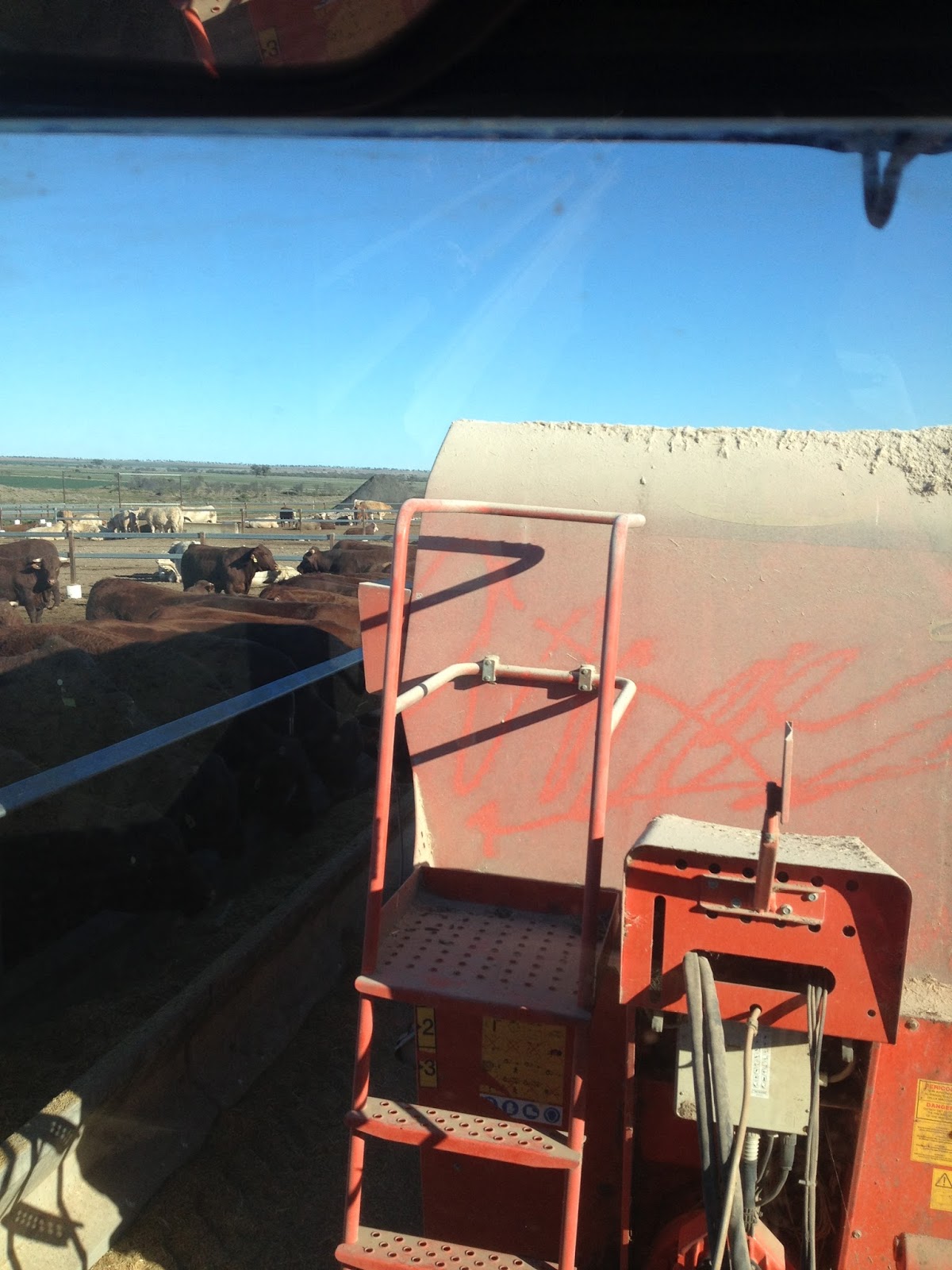
We had organised someone to come over and feed the cattle in the feedlot…..or so we thought. A feedlot is a very demanding master. Cattle must be fed at least once a day (sometimes more), rations mixed, waters cleaned and the feedlot checked several times a day (to make sure all animals are healthy, water is available, sufficient feed available, etc). Much like a dairy farm, it is very difficult to leave and ties you down to the place.
Finding employees is hard in this area. We have to compete against CSG(Coal Seam Gas) companies & service companies who pay big wages. The local town has rents that average $600/week for a house. It is also hard to find someone who is genuinely interested in feedlotting and farming.

Only six days out from the weekend we discover we have no one to feed, and we are hitting dead ends in finding alternatives. Meekly I pipe up with “Perhaps I could do it?”. I was very glad at this stage that the idea was rejected and I breathed a sigh of relief and went back to offering other suggestions.

I should explain at this stage that I do not drive a tractor. My mother told me never to learn so I did not have to sit there going around and around on a cultivation planting crops. I think it may be the fact that she used to have to drive a D6 Bulldozer with no cab at all (lovely Australian sun beating down on her) planting wheat may have been the reason behind her advice. She also told me never to marry a farmer (as in a cropping farmer). She should have mentioned feedlotters too I think. 

I do however drive a bobcat, and can operate a mixer. I also do all costings (working out costs of all components of a ration) on our rations so I know exactly what goes into a ration and at what ratio, but the finer points of mixing rations are not my domain. I assist with the induction of cattle and potter around cleaning waters, etc when able as I have three boys 5 and under who keep me house bound and busy.

So when hubby suddenly said “Right you’re it!” I suddenly felt sick. Sick at the responsibility that would now be mine. I believe at this point in time I was almost physically sick any time I gave the coming weekend too much thought.  Me and my big mouth and bright ideas!!

Perhaps the thing that worried me the most was the fact I must drive a bobcat with a bucket load of various commodities up a ramp and empty the bucket into a mixer.  Bobcats are sensitive machines, prone to propping and bucking under the drivers hands. The bucket is controlled by foot pedals while driving is controlled by the hands on sticks. Lots of things to be doing at once,  meaning lots of room for error. There was a lot of bunny hopping over bumps to and from the silage pit & also more terrifyingly up and down the ramp.

I sat there in the cab tense, so tense infact that when I got out it took along time for the muscles across the shoulders to relax and my hands were almost like claws from gripping the sticks so tightly. When I bunny hopped right at the top of the ramp there were so many deep breaths taken I was positively oxygenated well and truly. It probably sounded like I was going a round with Danny Green as the air sailed out of my cheeks like I had been punched. Then two small things made all the difference……1. I discovered I could move the seat forward so I had much better control over the pedals (yes I know der Freddy) and 2. I banned all from sitting there watching me and giving orders with flapping arms. Suddenly calm came to the cab of the bobcat and I had it all together (barring odd minor lapse in concentration).

The other thing to note is that it really is important that a lot of care be taken with the mixing of the rations. Ratios of the different commodities must be correct. Therefore we operate by the “if you are not happy with it don’t feed it motto”.  I had a lovely list of the exact amounts needed for each ration, removing the margin for error.
So after three days of intensive training & practice, hubby headed off with a procession of utes. It should possibly be noted here that it should have only taken them 3-4 hours to reach their destination, not the 12 hours via a scenic route that it did (mud map found still on kitchen table). The first morning of going it alone I arrived at the commodity shed and jumped into the tractor to warm it up only to find a lovely note pinned to the clipboard where all the ration information is kept…….”Remember to breath sweetheart. Piece of piss. You’ve got this.”

Strangely I discovered it was very peaceful without someone watching me (even if they were hiding around the corner trying not to be seen).  As long as I didn’t let my mind wander off on a tangent like thinking about jobs to be done at the house or the kids, I drove that bobcat like an old hand. The minute my mind wandered I spilt stuff, bunny hopped or collected something. The rations were mixed and successfully fed out. Cattle were happy and well behaved in the absence of the “boss”.


Not being a morning person I was surprised to discover how much enjoyment I got out of getting up in the cold and the dark to go down to the feedlot and prepare the mixes and feed out the ration. I am thinking it had more to do with the sense of achievement I got from being able to successfully complete my job without any complications (Husband’s friend who was “on call” for motor issues was not required).

I do love cleaning the waters in the feedlot. The cattle soon become quiet if they weren’t already. There is always one or two in every pen who are addicted to fresh clean water and are pushing past you while you are scrubbing the troughs as they can’t wait until you are done. The back of your shirt is often wet from being licked or chewed or having water dribbled down it while you are scrubbing. There is always one character in the feedlot who likes to make sure you are awake and up for a game of “Call your bluff”, which I lost on two occasions as I am sure it had passed the game and these couple of characters had developed more sinister intentions.  Or as you wander through the pen checking on the health of the cattle it resembles the school playground game of “What’s The Time Mr Wolf” as the cattle inch closer and closer behind you.


So to the outcome…..the mixer wears two new (small) scars from a bobcat bucket. The shed support is slightly bent at one point (although I am pleased to say I was not the first to do this). One bunker wall may not be as straight as it was. I did however remember to raise the elevator between feeding every pen removing the chance of tearing it off. The tractor well it was a piece of piss (hubby’s term).  Even found the light switch (it is an old tractor and it took some finding) so I could feed out at 4 am because the cattle were particularly hungry that night. All cattle were fed and happy, waters clean and mixed done correctly.

I finished my job feeling empowered, confident and proud that I was able to master and complete the tasks without any incident. I loved the fact that I surprised myself, my husband and his friends.


Agriculture has many areas where it becomes a man’s domain based often simply upon the strength required to complete a task. However women can do many things and should be encouraged to give it a go. Agriculture needs more people in every industry and everywhere throughout Australia. Male or female if you think you have a passion to be on the land, you can make it happen.  

Saturday, 15 June 2013

Farming Advocacy (or Agvocacy) 101


It has been a very eventful couple of years in the world of farmers on social media. For me it kicked off with the ABC Four Corners program “A Bloody Business”, regarding the Live Export of cattle to Indonesia and the cruelty encountered in some abattoirs at slaughter point.
It was at this time I entered into the social media world, firstly dipping my toe into the waters of Facebook only to lose a leg to the first activist I encountered. The leg was quickly followed by my temper as I watched all Australian farmers being branded cruel and evil. I am not proud of my first encounters. I struggled with my temper as I was horrified at the things that were being said about our hard working Australian Farmers.  People I know to be generous, kind and compassionate. People who work hard and encounter many difficulties daily yet keep on moving forward. Things like:

“All farmers with terminal illnesses should have their throats cut to see how painful it is”

Or

“Hand over your children and see if they scream”

As you can imagine, these types of statements got some very strong reactions from me and many other farmers who were following the threads. Sadly, however much I want to say this type of behaviour was confined to the activists’ side I cannot.

Now here we are over two years later. What have I learnt? Have I changed my tactics? Can I hold my temper? The answers are lots, definitely and most of the time.
So exactly what have I learnt as an Australian farmer? Gosh I am unsure of where to start here as I have learnt so much!

While initially shocked at the vitriol and hatred encountered and pointed squarely in the direction of Australian Farming, I learnt that not all people use social media to bully, defame and demean others.  There are many out there who are very genuine in their concerns and really want to understand what is entailed on a daily basis in different farming industries.
I learnt that many in the general public are quite removed from farming and how their food is produced, but only a handful are removed from their senses. Most people are happy to accept a factual polite explanation. Most people are reasonable.

I learnt that manners will create ongoing conversations and that there are many out there who while not actively involved in a conversation, still watch and can be reached never the less. I have learnt that you will never convince everyone, but to respect the different opinions out there. I have learnt that not only does religion start wars, but given time so will dietary arguments, especially when agendas are pushed by radical members of movements.  

I learnt that there was also a large and growing rural community on social media and contrary to the claims by some industry bodies that social media had no place in agriculture, these farmers have been able to prove otherwise. Many had been told to get the word out themselves and they have been doing an excellent job of it.  I have also learnt that rural Australia really is a small world which is a wonderful thing when it comes to closed social media groups and verification of members. It seems there is always someone who knows someone who knows someone. This is a great strength.

 I learnt that we farmers are far from silly when it comes to technology however rural technology just may not be able to keep pace with us! NBN? What NBN? Signal drop out or failure is the bane of a rural advocate.

There are so many things that I have learnt, but perhaps the biggest so far has been the fact that farmers can make a difference as shown with the back down by Coles from selling the Animals Australia Make it Possible campaign merchandise, solely due to the social media revolt by farmers. I only hope that the real reason for the massive backlash by farmers is being heard. Coles, who have suddenly made themselves the moral guardian of farming ethics (very same company now accused by the ACCC – Australian Consumer Competition Commission of misleading and deceptive marketing on a separate issue) aligned themselves with an organisation who are all about animal RIGHTS NOT animal WELFARE. An organisation who has repeatedly pushed an agenda to end all livestock farming, commencing with live export and intensive farming methods. An organisation who uses illegal methods of hidden surveillance  to obtain footage of what may or may not be cruelty (as it is heavily edited). To do so members trespass on farms which are not only businesses but family homes. From this edited footage they have pieced together an advertising campaign to illicit donations from the public. Not a single dollar will be spent on ensuring the welfare of a single animal however. This is where the outrage stems from. Social media provided farmers the perfect horse they could saddle up, muster support and stampede a major corporate company into retracting its poorly judged support for an organisation who had in their own minds been masters of the social media game.

So how have my tactics changed? There is actually a skill in getting your facts out there, and the Australian public really does trust its farmers. I have watched many very good rural advocates, people who had never really thought they would be at the forefront of rural advocacy. These clever, witty and genuine people have taught me many things.

So these are my top 12 of Farming Advocacy 101 ………….
  1. ENGAGE – Engage with the general public everywhere. In towns and cities. On buses, trains and planes.
  2. KEEP COOL – Expect resistance and at times agree to disagree and walk away from an argument before it deteriorates into personal attacks
  3.  PLAY THE BALL – Engage on the facts and argument, not the opponent. Personal attacks are not attractive and do not paint anyone in a good light.
  4. RESPECT – Respect the general public and their entitlement to an opinion that is different to yours. You can however ensure it is an educated opinion by offering facts to counter their opinion.
  5. FACTS – Use facts you know to be true based off actual experiences. These facts are always so believable simply because they are true.
  6. SHOW & TELL – Keeps photos of your farm and your animals and farm operations on your phone ready to show anyone who  may be interested when travelling. A picture says more than a thousand words, just ask an activist.
  7. POSITIVITY – When engaging others do so in a positive and polite manner and you will generally be treated in the same manner.
  8.  UNDERSTANDING – We can’t expect the general public to understand farming if we don’t tell them about it, but make sure explanations do not equal whinging. It is a fine line from the general public’s point of view
  9. SOLUTIONS – Be proactive and find solutions to problems. Talking about a problem repeatedly becomes tiresome if no solution can be found.
  10. IMPROVEMENTS -   Even the best farming operations have room for improvements, but make sure they can be on YOUR terms. Be proactive don’t wait to be told.
  11. RESPONSIBILITY – It has become clear that the responsibility for public perceptions lies with farmers and farmers are one of the most trusted professions in Australia. We are responsible for bringing about change and we are responsible for educating the Australian consumer about their food
  12. PROUD – Australian farmers are some of the most innovative in the world producing food that is clean, green and disease free. Hold your head up high as an Australian farmer and be proud. Share your pride in your farm, crops and animals. It is contagious.

Lastly……can I hold my temper? Hmmm I will say most of the time. I try hard and revert to pasting facts I have stashed away when someone has stirred the pot a little too hard. I sometimes write several scathing replies, but never post them and then walk away. Or at least most of the time I do………………….. 


Don't let the sun set on Australian Agriculture